- Quick Disconnect Systems: What They Do and Why They Are Used
- Understanding Pressure in Quick Disconnect Systems
- Flow: Where Quick Disconnect Choices Often Go Wrong
- Hose Compatibility: Where Most Connection Problems Begin
- Why Pressure, Flow, and Hose Compatibility Must Be Considered Together
- Where Imbalance Shows Up in Real Operations
- How This Plays Out Across Different Job Sites
- Making Better Selection Decisions Before Installation
- Keeping Systems Reliable Over Time
When a fluid system fails, it is rarely because of a single component. Most of the time, the problem comes from how the different parts were matched. Pressure ratings do not line up, flow gets restricted at the connection point, or the hose simply is not meant to work with the quick disconnect being used. These issues often show up only after the system is running.
Quick disconnect systems are meant to make work easier. They allow faster setup, quicker maintenance, and safer connections in the field. But they only work as intended when pressure limits, flow requirements, and hose compatibility are properly considered together. Ignoring any one of these can lead to leaks, pressure loss, or repeated connection failures.
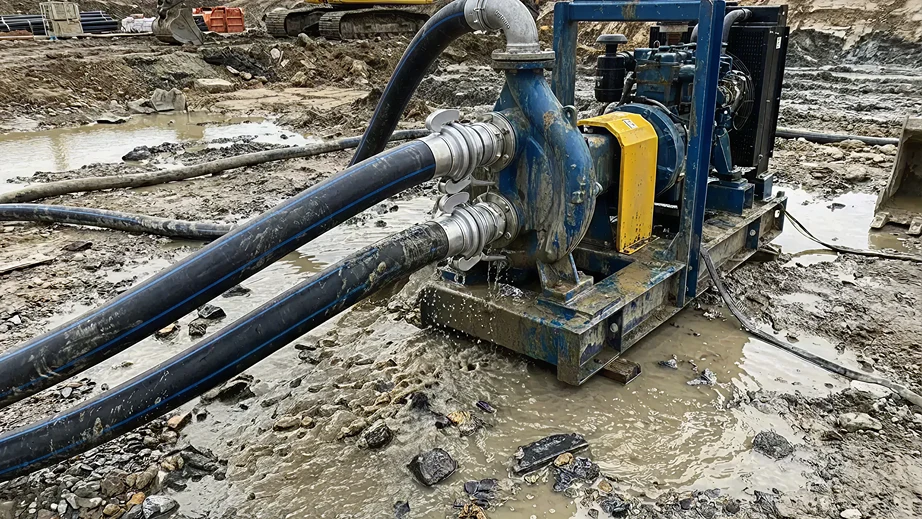
In applications like construction dewatering, slurry transfer, or temporary water bypass, these details matter every day. Crews need systems that connect quickly but also hold up under continuous high pressure and flow. This is why the hose, the fitting, and the quick disconnect cannot be chosen in isolation.
At Anaconda Pipe & Hose, quick disconnect systems are used as part of complete hose and pipe systems, not as add-on accessories. Pressure ratings, internal diameters, and coupling types are selected to work together so the system performs the same on-site as it does on paper.
This blog examines how pressure, flow, and hose compatibility affect quick disconnect systems, and what to consider when building a setup that must perform reliably in real operating conditions.
Quick Disconnect Systems: What They Do and Why They Are Used
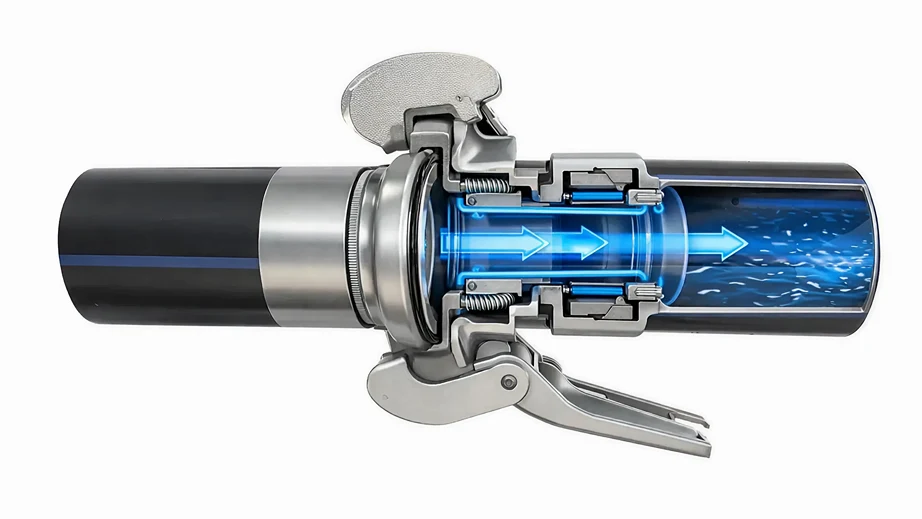
A quick disconnect system is a connection method that allows hoses or pipes to be joined and separated without tools. It usually consists of two parts that lock together securely and can be released when needed. The main purpose is speed, safety, and repeatability, especially in systems that are often assembled and dismantled.
In industrial operations, time spent tightening or loosening traditional couplings adds up quickly. Quick disconnect systems reduce that time and also lower the risk of incorrect installation. When properly selected, they create a consistent connection every time, even in demanding site conditions.
These systems are commonly used where hoses are regularly moved, replaced, or extended. Dewatering setups, temporary bypass lines, slurry pumping, and emergency water transfer all rely on quick disconnect systems to keep work moving without long shutdowns. In these situations, operators need connections that are fast yet strong enough to withstand continuous operation.
However, quick disconnect systems are not universal components. Each design has limits on pressure, flow capacity, and the types of hose it can safely connect to. Using the wrong disconnect for a specific hose or application can restrict flow or stress the connection point.
This is why, in industrial setups, quick disconnect systems must be selected alongside the hose and pipe system rather than after. At Anaconda Pipe & Hose, these connections are typically paired with compatible hoses and pipes so that the full system works as intended, not just the connection itself.
Understanding Pressure in Quick Disconnect Systems
Pressure is one of the first limits a fluid system encounters, especially at connection points. A hose may be rated for high pressure, but the system is only as strong as its weakest part. Quick disconnect systems often become that weak point when pressure ratings are overlooked or misunderstood.
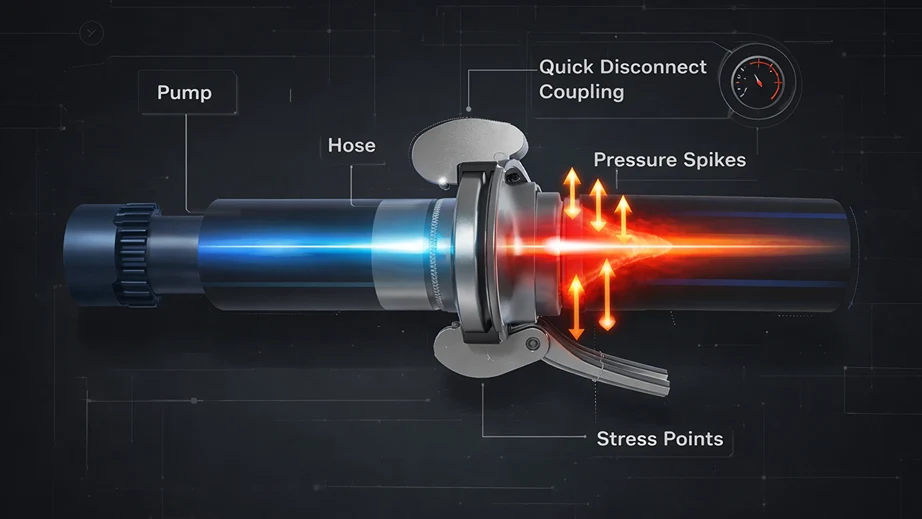
In practical terms, pressure refers to the force pushing fluid through the hose. This force increases during pump startup, sudden valve closure, or when blockages occur downstream. Quick disconnect systems must be able to handle not only normal operating pressure but also short pressure spikes that occur during real use.
Problems usually appear when the pressure ratings between the hose and the disconnect do not match. A disconnect rated lower than the hose can deform, leak, or fail even if the hose itself remains intact. Over time, repeated pressure stress can also loosen the connection, especially in systems that run continuously.
This is why pressure should always be evaluated at the system level. Flow rate, pump capacity, and operating conditions all affect the pressure the disconnect experiences. In high-pressure dewatering or slurry applications, this becomes even more critical.
Anaconda Pipe & Hose addresses this by pairing quick disconnect systems with hoses and pipes that share compatible pressure ratings. This reduces stress at the connection point and helps maintain system integrity throughout the job, rather than just at installation.
Flow: Where Quick Disconnect Choices Often Go Wrong
Flow problems usually do not show up as sudden failures. They show up as slow performance, uneven discharge, or pumps working harder than expected. In many cases, the cause is not the pump or the hose, but the quick disconnect sitting between them.
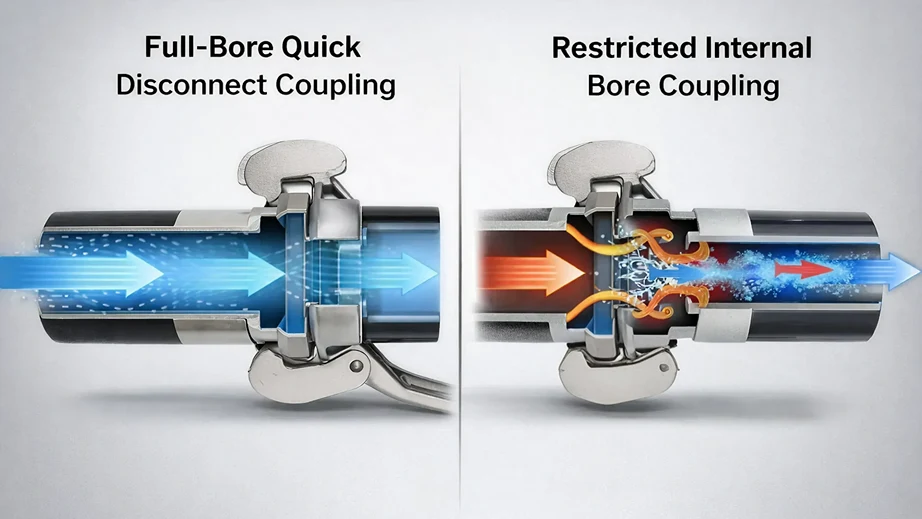
Flow is affected by the internal diameter, the connection shape, and the smoothness with which fluid can move through the system. When a quick disconnect has an internal bore smaller than the hose, it creates a choke point. Even a small reduction in the connection can limit overall flow, especially in high-volume pumping applications.
This becomes more noticeable in systems designed for continuous transfer, such as dewatering lines or slurry movement. Reduced flow can increase upstream pressure, leading to increased wear on hoses, fittings, and pumps. With time, this imbalance decreases the machine’s life and increases operating costs.
Another common issue is the mistaken belief that a matching nominal size guarantees proper flow. Two components labeled the same size may have very different internal profiles. Without checking actual flow paths, the system can underperform even when everything appears compatible.
At Anaconda Pipe & Hose, flow considerations are built into how quick disconnects are matched with hoses and pipes. Internal diameters and connection geometry are selected to maintain consistent flow across the system, helping pumps operate within their intended range instead of compensating for hidden restrictions.
Hose Compatibility: Where Most Connection Problems Begin
Most connection problems start at the hose, even when the fitting looks fine. If the hose is not meant to work with the quick disconnect, issues show up slowly.
Sometimes the hose wall is too soft. Sometimes it is too stiff. Under pressure, the hose end can stretch or compress around the connection. That puts stress right where the disconnect locks in. Over time, this leads to leaks or damage near the coupling.
Another issue is how the hose behaves when the flow changes. A hose designed for low movement may not handle frequent connect and disconnect cycles well. The connection holds at first, then loosens after repeated use. This is common on temporary pumping lines and mobile setups.
Material choice also plays a role. A hose used for slurry behaves very differently from one used for clean water. Abrasion, weight, and vibration all affect the connection point. If the disconnect does not suit the hose construction, the problem shows up during operation, not installation.
This is why hose compatibility cannot be assumed just because sizes match. The hose, the quick disconnect, and the operating conditions need to align. When they do not, the system still runs, but never as smoothly or as long as expected.
At Anaconda Pipe & Hose, hoses and quick disconnect systems are usually supplied together for this reason. The goal is to avoid field adjustments later by making sure the connection works with the hose from the start.
Why Pressure, Flow, and Hose Compatibility Must Be Considered Together
Pressure, flow, and hose compatibility cannot be treated as separate checks. They affect each other whether planned or not. When flow is restricted, pressure builds. When pressure increases, the hose and connection take more load. Suppose the hose is not fully compatible with the quick disconnect, and the load concentrates at the joint. This is where systems start leaking or failing.
Many systems look correct on paper but behave differently once running. A pump delivers more flow than expected. The disconnect limits it slightly. Pressure rises upstream. The hose flexes more than intended. None of this happens instantly, but it adds up during daily operation.
This is why selecting parts one by one often creates problems later. A high-pressure hose does not guarantee system strength if the disconnect restricts flow. A large-diameter hose does not help if the coupling narrows the flow path. Compatibility is not a single decision. It is a balance.
In practical setups, the goal is consistency. Pressure and flow should stay within limits. Flow should move without sudden restrictions. The hose should support both without changing shape or stressing the connection. When these conditions are met, the system runs predictably.
This is the approach taken when Anaconda Pipe & Hose builds hose and pipe systems around quick disconnect systems. The focus is not just on connection speed, but on how the entire system behaves once it is operating.
Where Imbalance Shows Up in Real Operations
Most system issues do not appear during installation. They show up once the system has been running for some time. Connections start leaking, hoses wear faster near the ends, or pumps work harder than they should.
On dewatering sites, this often looks like frequent reconnections or unexpected shutdowns. In slurry applications, the hose may hold pressure but lose flow efficiency. Operators may adjust clamps or replace parts without realizing the root cause is an imbalance between pressure, flow, and hose compatibility.
Another sign is uneven wear. If the hose looks fine along its length but fails near the quick disconnect, the problem is usually at the interface. Flow restriction or pressure stress concentrates at that point. Over time, even a well-rated hose can degrade early.
Temporary systems are especially vulnerable. These setups are moved, extended, and reconnected regularly. If the quick disconnect and hose are not meant to work together, every reconnect adds a small amount of stress. The system still runs, but reliability drops.
This is why experienced operators focus less on individual components and more on how the system behaves during daily use. When pressure and flow, and hose compatibility are balanced, issues become predictable, and maintenance becomes routine rather than reactive.
How This Plays Out Across Different Job Sites
In construction dewatering, systems are often assembled quickly and expected to run without attention. If pressure and flow are not balanced at the quick disconnect, crews notice it in small ways first. Pumps cycle more often. Discharge feels weaker than expected. Connections need tightening more than once. These are early signs, not random issues.
In slurry or abrasive material transfer, the effects show up faster. Any restriction at the disconnect increases wear. The hose near the connection takes the load, especially when the flow fluctuates. Over time, failures tend to occur close to the coupling rather than along the hose length.
Municipal bypass and temporary water transfer bring a different challenge. These systems may run continuously for long hours. Even a minor pressure and flow imbalance or restriction becomes a reliability issue when the system is not shut down daily. A connection that works for short-term use may struggle under constant operation.
Across these applications, the pattern is the same. When quick disconnects are selected without considering how they interact with hose type, pressure range, and flow demand, performance drops gradually. When they are selected as part of a matched system, the setup stays stable with fewer adjustments.
This is why system planning matters as much as product selection. Matching components to real operating conditions reduces surprises once the system is live.
Making Better Selection Decisions Before Installation
Most issues can be avoided before the system ever reaches the site. The problem is that selection is often rushed or based on what is already available rather than what the system actually needs.
The first step is understanding how the system will operate, not just how it will be installed. Expected flow rate, normal operating pressure, and possible pressure and flow spikes should be clear from the start. These factors influence which quick disconnect and hose type will work reliably together.
Next is checking how the internal sizes line up. A hose and disconnect may share the same nominal size, but their internal flow paths may differ. If the disconnect reduces flow, the pump compensates by increasing pressure. This shifts stress to the hose end and the connection.
Material and construction also matter. A flexible lay flat hose behaves differently from a rigid pipe or a slurry hose. The quick-disconnect systems must accommodate that behavior, especially in systems that are often connected and disconnected.
At Anaconda Pipe & Hose, these decisions are usually made together rather than separately. Hoses, pipes, and quick disconnects are selected as part of one system, so pressure limits, flow needs, and compatibility are aligned before installation begins.
Taking time at this stage reduces on-site fixes later and helps the system perform consistently once it is running.
Keeping Systems Reliable Over Time
A system that is balanced at the start is easier to keep running. When pressure and flow stay within limits, the course remains consistent, and the hose is properly matched to the quick disconnect systems, there is less need for constant adjustment on site.
Most long-term issues come from small compromises made early. A disconnect that is “almost right” or a hose chosen for convenience may work at first, but the system becomes harder to manage over time. Connections loosen, wear appears near the ends, and performance becomes inconsistent.
Regular inspection helps, but it does not replace proper selection. When components are compatible from the start, maintenance becomes routine rather than reactive. Crews spend less time fixing connections and more time operating the system.
This is why comprehensive system planning is essential in industrial fluid handling. Pressure, flow, and hose compatibility are not independent checks. They define how the system behaves every day it is in service.
Anaconda Pipe & Hose approaches quick disconnect systems with this long-term view. By matching hoses, pipes, and connections to real operating conditions, the focus stays on reliability rather than repeated correction.
0 Comments