- Why Chemical Transfer Lines Fail
- How Chemical Compatibility Is Actually Assessed
- What to Confirm Before You Specify
- Comparing the Main Options for Chemical Service
- Where Each Option Fits and Where It Does Not
- Practices That Extend Service Life
- How Anaconda Approaches Chemical Transfer
- Frequently Asked Questions
Most chemical transfer failures are not exotic. They trace back to a hose selected on nominal size and pressure rating alone, with compatibility assumed rather than checked. This guide explains how compatibility is assessed, which operating variables change the answer, how to compare hose and pipe options for chemical service, and what information your supplier needs to make a defensible recommendation.
Why Chemical Transfer Lines Fail
A chemical transfer line rarely fails for one reason. It fails because several conditions stack up on a component that was marginal from the day it was installed.
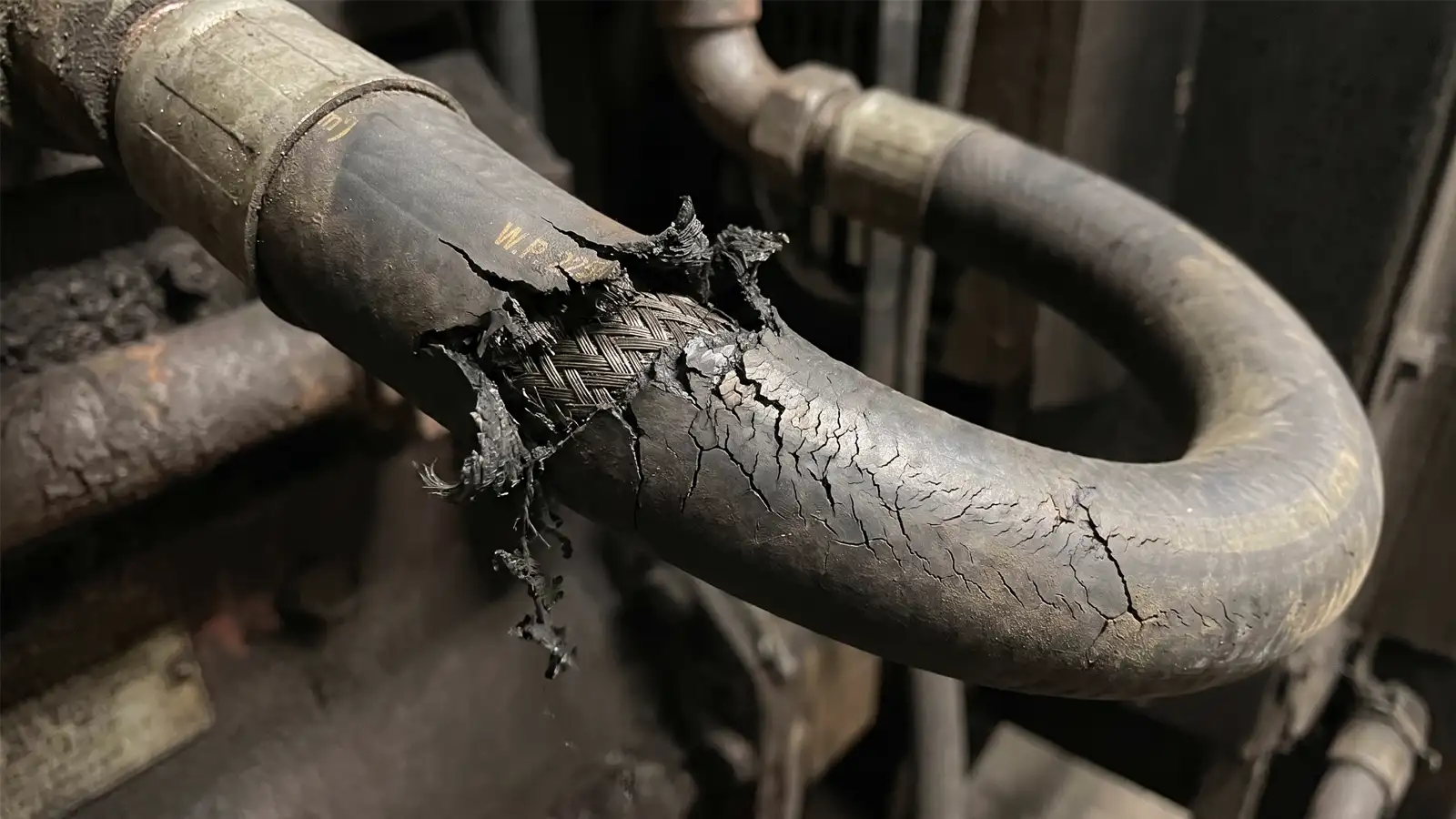
The most common pattern is chemical attack on the liner. The tube softens, swells, blisters, or hardens and cracks. Flow does not stop, so the problem stays invisible until the reinforcement is exposed and the hose ruptures under normal working pressure. By then the failure is not a maintenance event. It is a spill, a shutdown, and in many plants a reportable incident.
The second pattern is thermal. A hose rated for a chemical at ambient temperature may lose a significant share of its working pressure capability at elevated temperature, and chemical attack usually accelerates with heat as well. A line that performs through winter can begin failing in summer, or after a process change raises the transfer temperature.
The third pattern is mechanical. Kinking, crushing, over-bending near couplings, dragging across grating, and repeated flexing all damage reinforcement long before the liner shows anything. Hoses stored coiled too tightly or left in direct sunlight between campaigns arrive at the next job already degraded.
The fourth pattern is the connection. Couplings and gaskets are part of the wetted path, and they are frequently specified by convenience rather than compatibility. A correctly selected hose with an incompatible gasket still leaks at the joint.
The operational cost is consistent across all four: unplanned downtime, emergency replacement at premium pricing, cleanup, and the labor hours that follow any chemical release, however small.
How Chemical Compatibility Is Actually Assessed
Compatibility is not a yes-or-no property of a hose. It is a judgment about a specific material, in contact with a specific fluid, under specific conditions, for a specific duration.
The Whole Wetted Path Has to Be Checked
Every surface the chemical touches needs to be evaluated: the inner tube or liner, any exposed reinforcement at cut ends, the coupling body and stem, the gasket or seal, and the pipe or fitting on either side of the hose. Compatibility charts are published by material rather than by product, so the practical step is to identify each wetted material by name and check each one.
Concentration, Temperature, and Contact Time Change the Result
The same material can be rated suitable for a dilute acid and unsuitable for the concentrated form. Temperature changes both the rate of chemical attack and the pressure the hose can safely hold. Contact time matters as well: a material acceptable for intermittent transfer with a thorough flush afterward may not be acceptable for a line that stays full between batches. Continuous service, batch service, and emergency standby are three different specifications even when the chemical is identical.
Permeation and Absorption Are Slow Failures
Some fluids do not attack a liner so much as move through it. Over time, permeation can degrade the reinforcement from the inside, blister the cover, or create an odor and exposure issue around the line. Absorption produces swelling, dimensional change, and loss of strength. Neither shows up in a pressure test on day one, which is why service history and manufacturer guidance matter more than a single hydrostatic result.
Pressure Ratings Are Not Fixed Numbers
Published working pressure assumes stated conditions. The number that matters is the maximum pressure the line will actually see, including pump shutoff head, static head, valve closure surge, and any pressure developed during line clearing or blowdown. Vacuum service is a separate question: a hose with adequate pressure capability may still collapse under suction unless it is built for it. Confirm both the pressure rating and any temperature derating with the manufacturer before specifying.
What to Confirm Before You Specify
A supplier can only recommend responsibly if the request includes the operating reality, not just the size. Before requesting a recommendation, gather the chemical name and concentration, noting whether the stream is a single chemical or a mixture; the normal and maximum operating temperature, including ambient exposure; the maximum system pressure, including surge and pump shutoff conditions; whether the line will see vacuum; solids content, particle size, and abrasiveness if the stream is a slurry; the flow rate and required internal diameter; the length, routing, bend radii, and support arrangement; the end connection standard already used on the plant side; the duty cycle, meaning continuous, batch, or standby; whether and how the line will be flushed; outdoor exposure, including UV and temperature extremes; and the expected service life and inspection interval.
Comparing the Main Options for Chemical Service
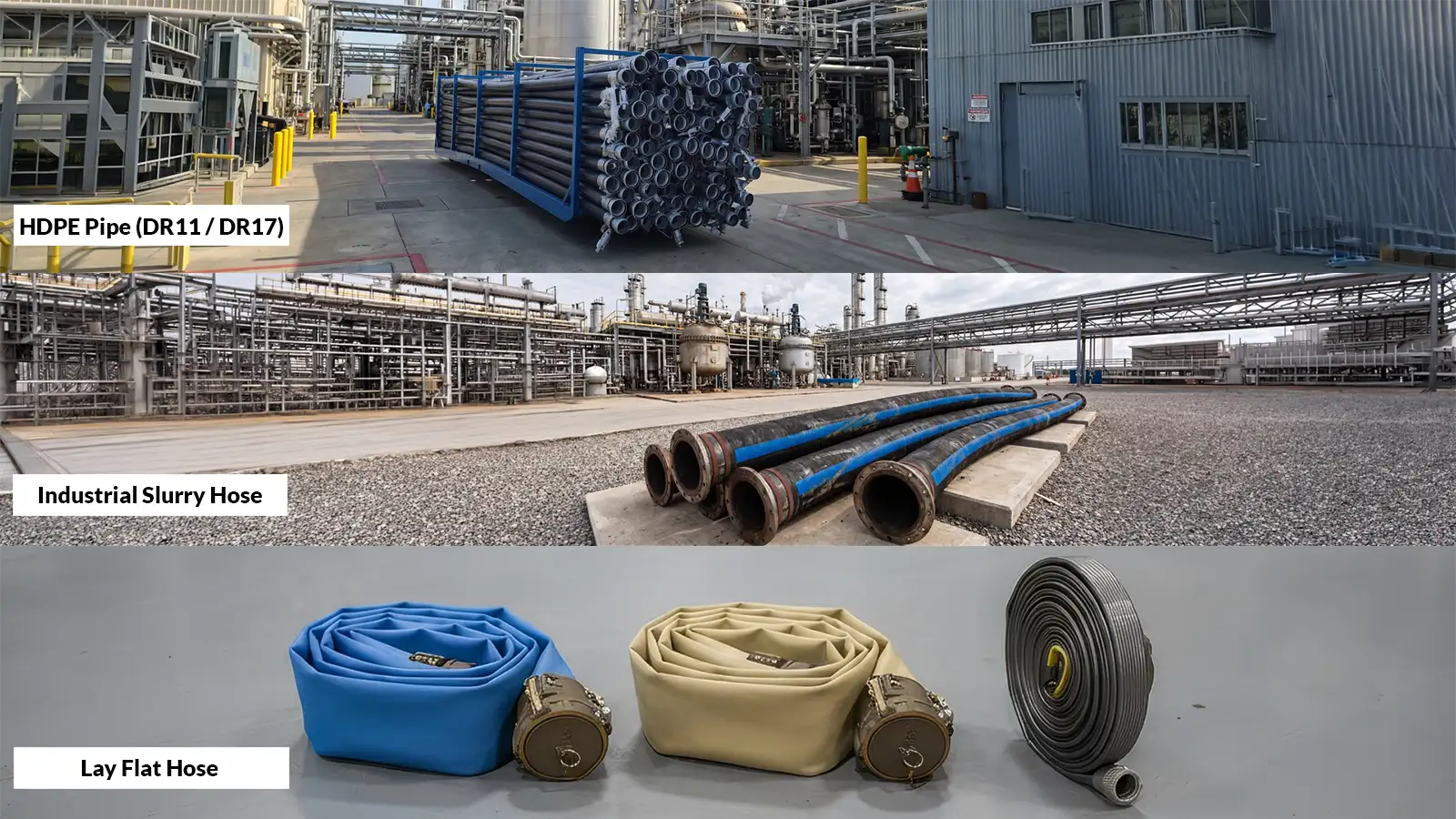
Anaconda supplies three product families used in chemical transfer, and they are not interchangeable. The table below summarizes where each one fits.
Criteria |
HDPE Pipe (DR11 / DR17) |
Industrial Slurry Hose |
Lay Flat Hose |
|---|---|---|---|
Best-fit role |
Permanent and semi-permanent chemical transfer, feed lines, effluent routing, secondary containment |
Abrasive and corrosive slurry at pump discharge and other high-wear sections |
Temporary, mobile, and emergency routing; bypass and washdown lines |
Chemical resistance |
Broad resistance to acids, alkalis, and many solvents; confirm per fluid |
Depends on liner compound; confirm per fluid and concentration |
Depends on construction; confirm for the specific product, not the category |
Abrasion handling |
Moderate; depends on velocity and particle size |
High, for solids-loaded streams |
Moderate; better suited to intermittent flow |
Pressure capability |
Set by DR rating; DR11 higher than DR17 |
Suited to pressurized slurry pumping |
Varies widely by construction |
Connections |
Mechanical couplings or Bauer-style quick connect |
ANSI 150 flanged ends or custom connections |
Couplings, manifolds, and adaptors |
Handling |
Lightweight for its class; needs planned alignment and support |
Heavier; larger sizes need mechanical handling |
Lightest; fast to deploy, retrieve, and store |
Main limitation |
Not suited to frequent rerouting or continuous flexing |
Cost and weight are hard to justify for clean, low-abrasion service |
Not a permanent installation |
Where Each Option Fits and Where It Does Not
HDPE pipe suits permanent and semi-permanent chemical transfer where corrosion resistance and a long, low-maintenance service life are the priority. It is a common alternative to metal pipe in corrosive service, and the smooth bore helps limit scaling and flow loss. It is a poor choice where the route changes frequently, where the line must be removed and redeployed regularly, or where continuous flexing is required.
Industrial slurry hose suits streams that carry abrasive solids alongside chemical exposure — catalyst media, abrasive byproducts, and neutralization sludges — and it is the usual choice at pump discharge and other high-wear points. Anaconda supplies it in 4-inch through 12-inch sizes with ANSI 150 flanged ends or custom connections. It is heavier to handle than lay flat hose and is not the economical choice for clean, low-abrasion fluid at moderate pressure.
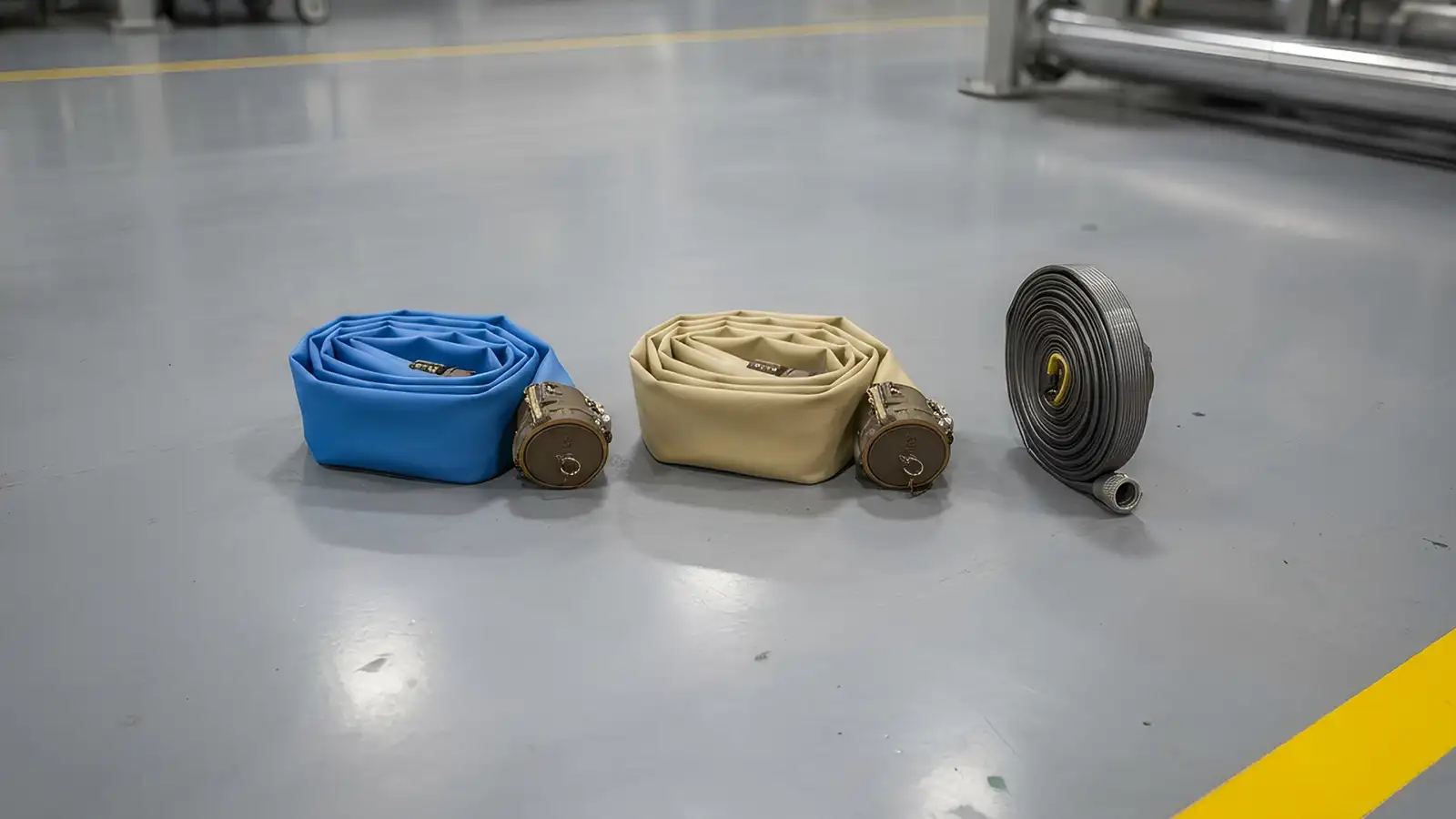
Lay flat hose suits temporary transfer, shutdown bypass, washdown, and emergency redirection, where fast deployment, compact storage, and long continuous lengths that reduce joint count are the deciding factors. It is not intended as a permanent installation, and its suitability for a given chemical depends heavily on the specific construction, so compatibility has to be confirmed for the exact product rather than the category.
In many plants the correct answer is a combination: fixed pipe on the backbone, slurry hose at the abrasive discharge points, and lay flat hose staged for bypass and shutdown work.
Practices That Extend Service Life
Selection sets the ceiling on service life; handling determines whether you reach it. Respect the published minimum bend radius, especially near couplings where reinforcement is already under stress. Support long runs so the hose is not carrying its own filled weight across a span. Flush lines according to a written procedure after chemical service, and record it. Inspect on a schedule rather than on failure, looking for cover blistering, soft or hardened sections, coupling movement, and cracking near the ends. Store hoses clean, drained, loosely coiled, and out of direct sunlight. Tag each hose with the chemical it is dedicated to, and do not reassign it without rechecking compatibility.
How Anaconda Approaches Chemical Transfer
Anaconda supplies HDPE pipe, industrial slurry hose, and lay flat hose for chemical processing rather than a single product line, which means the recommendation can follow the application instead of the catalog. Chemical-resistant HDPE pipe in DR11 and DR17 is used for chemical transfer, feed lines, effluent routing, and secondary containment. Slurry hose covers abrasive and corrosive streams at pump discharge and other high-wear sections. Lay flat hose covers temporary and emergency routing.
Bauer-style quick-connect fittings on the pipe side reduce field assembly time on projects where the layout changes, and rental is available where the requirement is project-length rather than permanent. The selection process starts with a media compatibility review, then works through pressure, temperature, abrasion, routing, and connection standards before a size or product family is confirmed.
Frequently Asked Questions
How do I know whether a hose is compatible with my chemical?
Identify every wetted material by name, then check each one against a chemical compatibility chart at your actual concentration and temperature. Confirm the result with the manufacturer for the specific product, since construction varies within a category.
Does a higher pressure rating make a hose safer for chemical service?
Not on its own. Pressure rating and chemical compatibility are independent. A hose can exceed the pressure requirement and still fail quickly if the liner is attacked by the fluid.
Can the same hose be used for more than one chemical?
Only when every chemical involved has been checked against the wetted materials and a flushing procedure is defined between services. Dedicating hoses to a single chemical and tagging them accordingly is the lower-risk practice.
How does temperature affect hose selection?
Temperature reduces the working pressure a hose can hold and usually accelerates chemical attack. Both effects have to be applied at the maximum operating temperature, not the average.
When should I use HDPE pipe instead of hose?
When the line is permanent or semi-permanent, the route is stable, and long service life with minimal maintenance is the objective. Hose is the better choice when flexibility, mobility, or rapid deployment matters more.
What connection options are available?
Slurry hose is generally supplied with ANSI 150 flanged ends or custom connections. HDPE pipe uses mechanical couplings or Bauer-style quick-connect fittings. Lay flat hose connects through couplings, manifolds, and adaptors. Gasket material is part of the wetted path and must be checked for compatibility.
How often should chemical transfer hoses be inspected?
On a defined schedule based on chemical aggressiveness, temperature, duty cycle, and consequence of failure. Visual inspection before each use, plus a documented periodic inspection, is a reasonable starting point for most plants.
Can hoses be used outdoors in chemical service?
Yes, provided the construction suits UV exposure, temperature extremes, and the handling frequency involved. Outdoor exposure should be stated when requesting a recommendation.
Talk to Anaconda About Your Chemical Transfer Application
Chemical transfer is a systems question, not a product question. The hose, the pipe, the fittings, the gaskets, the pressure conditions, and the temperature range all have to agree before the line is safe to run.
Send Anaconda the chemical and concentration, operating temperature and pressure, solids content, flow rate, line length and routing, connection standard, and duty cycle. The technical team will work through compatibility and pressure requirements and recommend a pipe and hose configuration built around your actual service conditions.
0 Comments