- When Does Renting a Lay Flat Irrigation Hose Make Sense?
- Which Agricultural Lay Flat Hose Should You Rent?
- Choosing the Correct Hose Size, Flow and Operating Pressure
- What Should Be Included in Your Hose Rental?
- Rental vs. Purchase vs. Permanent Irrigation Pipe
- Plan Seasonal Delivery, Field Routing and Return
- What to Have Ready Before You Request a Rental Quote
- Frequently Asked Questions
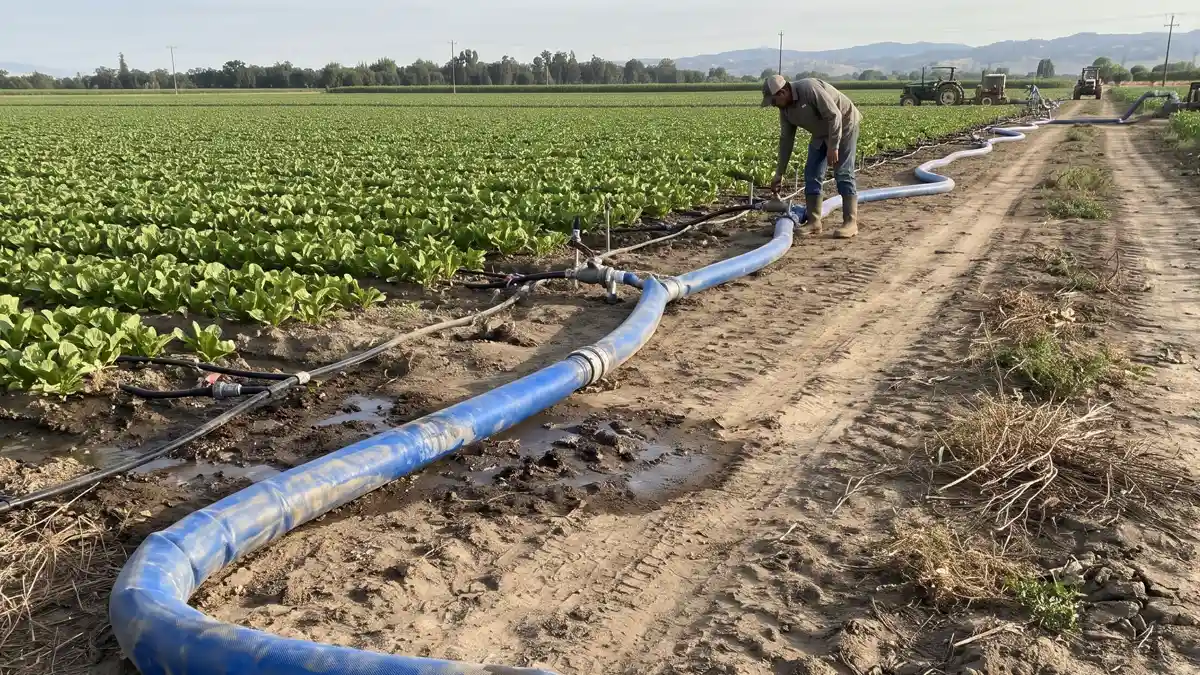
Renting a lay flat hose makes sense when your farm water transfer is seasonal, temporary or uncertain: a crop-season irrigation run, leased acreage, a backup line during a pump or canal outage, or a field you will not irrigate the same way next year. Buying hose or installing permanent pipe starts to win when the same route runs every season. Either way, choose the hose from five inputs: the media being moved, flow, route length, elevation, and the pressure your equipment needs at the outlet. Acreage alone will not size a line. At Anaconda Pipe and Hose, we rent Premium 200 for irrigation water and Drag Hose for liquid manure and slurry, and we help match diameter and fittings to your pump and route.
When Does Renting a Lay Flat Irrigation Hose Make Sense?
Quick answer: Rent when the hose will work for a season or less, when you farm land you do not own, or when you need supply back quickly. Buy or go permanent when the same route runs every year for many years. Short deployments, changing field layouts and one-off emergencies are where rental removes the most risk.
Leased ground is common. USDA’s Economic Research Service reports that 39 percent of U.S. farmland was rented in 2022, and that more than half of the cropland in the contiguous states is rented. A permanent pipeline on land you may not farm next year is a hard investment to justify. A rented hose line moves when your acres do.
Five situations tend to point toward rental:
- Seasonal crops: you need water for a growing window, then the line comes out.
- Leased acreage: you want supply without building infrastructure on someone else’s land.
- Backup supply: a pump fails or a canal shuts off and the crop cannot wait.
- Changing layouts: rotations or new fields change the route from year to year.
- Trial runs: you want to prove a traveler or mainline route before committing capital.
If you are comparing the whole range first, our lay flat hose types and applications page covers sizes, constructions and fittings across industries.
Which Agricultural Lay Flat Hose Should You Rent?
Match the hose to what moves through it before you match it to the field. We divide our agricultural rental range by media: Premium 200 irrigation traveler hose for irrigation water, and agricultural drag hose for liquid manure for slurry and nutrient-rich liquids. Mixing them up is the costliest selection mistake on a farm line, so keep them apart. Our agricultural lay flat hoses overview shows both side by side, and our agricultural water transfer solutions page puts them in the wider farm context.
Premium 200 |
Drag Hose |
|
|---|---|---|
Designed for |
Clean irrigation water supply, traveler systems and long-run water transfer from reservoirs, canals and ponds |
Liquid manure, slurry, municipal sludge, biosolids and nutrient application |
Construction |
Reinforced nitrile rubber, through-the-weave |
TPU tube and cover, through-the-weave, polyester reinforcement |
Listed sizes |
3, 4, 4.5 and 5 in |
5, 5-1/2, 6 and 7-1/4 in |
Listed working / burst pressure |
Up to 300 / 600 psi |
250 / 500 psi |
Movement |
Traveler supply, per datasheet |
Pulled behind agricultural equipment |
Not intended for |
Slurry, manure or nutrient media |
Potable water or lightweight irrigation-only use |
A note on materials. Many searches for agricultural lay flat hose specify polyethylene or PVC. Neither hose above is PE or PVC: Premium 200 is reinforced nitrile rubber and Drag Hose is TPU. Construction affects weight, flexibility, abrasion resistance and pressure rating, so confirm the construction on the datasheet instead of assuming one lay flat hose behaves like another.
Movement matters as much as media. Drag Hose is described as built to be pulled behind agricultural equipment, while Premium 200 is aimed at irrigation water supply and traveler systems. Ask which motion the datasheet approves before you plan a route, because a hose approved for one kind of movement is not automatically approved for another.
Choosing the Correct Hose Size, Flow and Operating Pressure
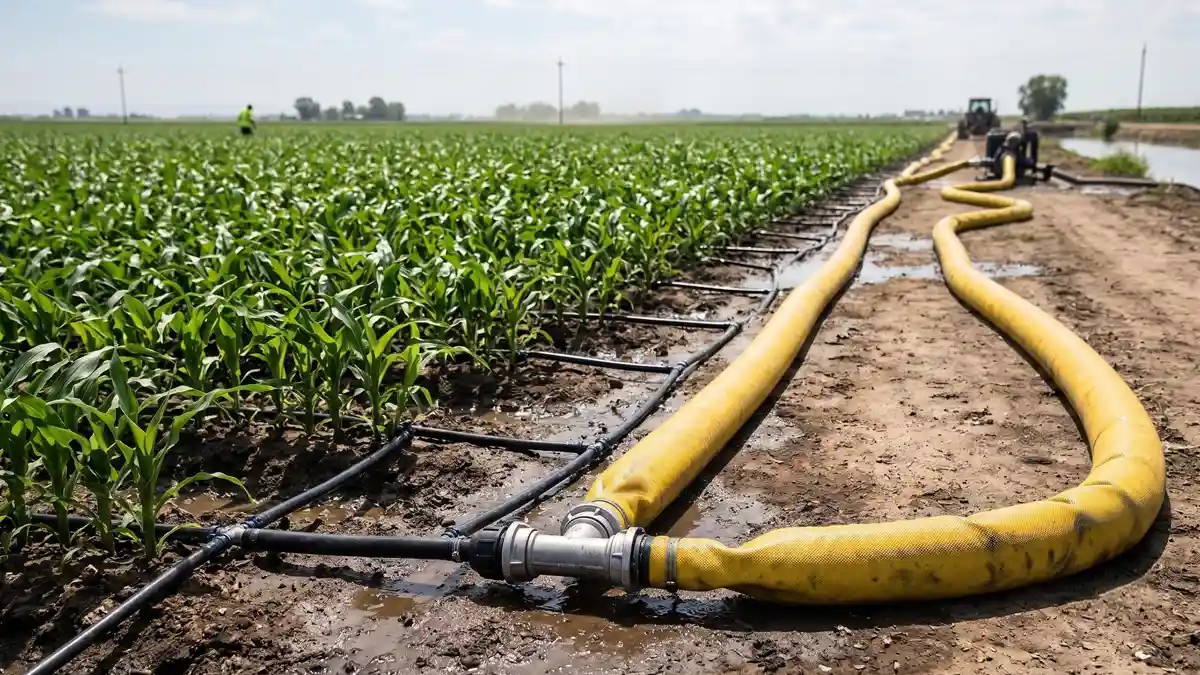
Size the hose from the hydraulics, not the acreage. We start with the pump curve and work out how much pressure is left at the outlet after the line has taken its share. Five inputs control the answer: flow in gallons per minute, the hose’s actual internal diameter, route length, elevation change, and the pressure your equipment needs at the end of the line.
What Drives Pressure Loss
Pressure budgeting is routine on modern farms. USDA reports that about 67 percent of irrigated cropland acres used pressurized systems in 2018, which means every foot of hose between the pump and the sprinkler has to earn its pressure drop.
Water loses pressure as it moves. UF/IFAS Extension explains that faster flow, longer runs, smaller inside diameters and rougher walls all increase friction loss, and that total head is the sum of static (elevation), velocity and friction components. It also gives the conversion we use in every example: 1 psi is about 2.31 feet of head. Fittings add loss as well. Washington State University’s pipeline pressure loss calculator notes that fittings act like extra length added to the pipeline.
Traveler systems show why this matters. Alabama Extension’s guidance on cable tow travelers says the traveling gun typically needs about 80 to 90 psi, and describes travelers as high energy users because of the high-pressure gun and the high-loss flexible hose feeding it. Gun requirements differ by model, so work from your traveler’s spec sheet.
Nominal size is not the same as internal diameter. When you compare hoses, compare effective internal diameter under pressure, because a 4 inch hose from one maker is not interchangeable with another. We recommend asking for the manufacturer’s friction loss data for the exact hose at your flow and length rather than borrowing a generic pipe table.
Worked Example: Sizing a Temporary Irrigation Transfer Line
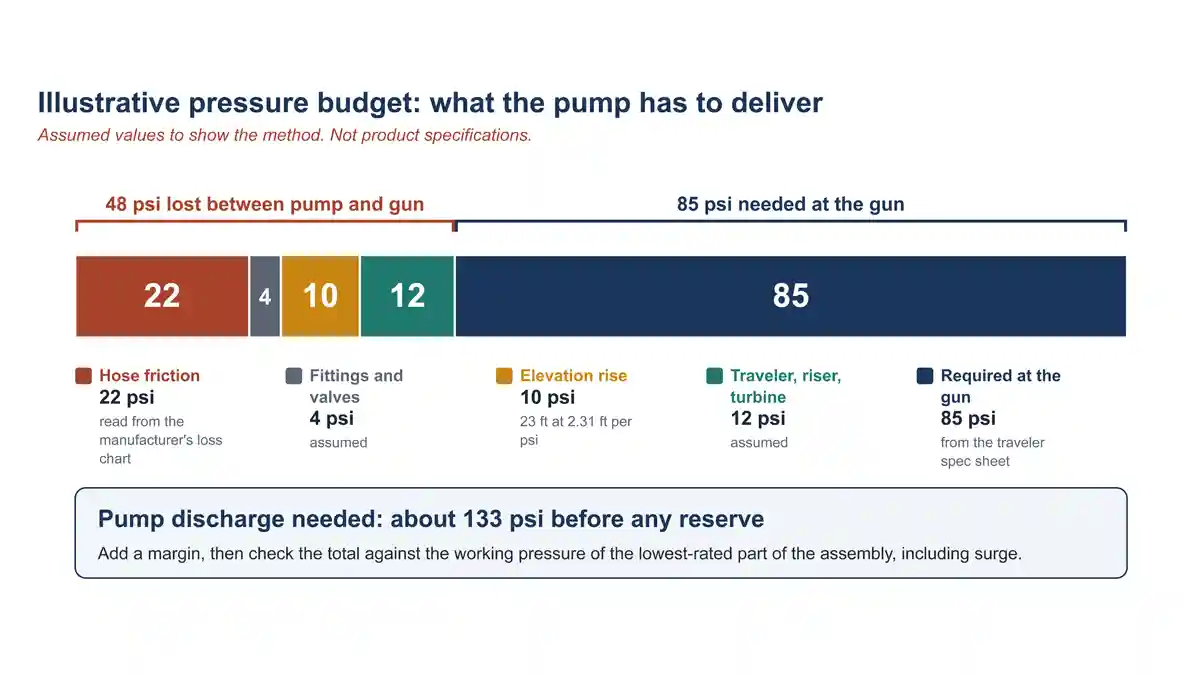
Here is the arithmetic we use to frame a sizing conversation. Every number below is an assumption chosen to show the method, not a product specification. Work backward from the outlet and add each loss:
- Pressure required at the gun: 85 psi, inside the typical range above and taken from the traveler’s spec sheet.
- Traveler, riser and turbine losses: 12 psi, assumed.
- Elevation rise: 23 feet, which is about 10 psi (23 divided by 2.31).
- Hose friction loss: 22 psi, read from the manufacturer’s loss chart at your flow, length and internal diameter. The figure here is assumed.
- Fittings and valves: 4 psi, assumed.
Figure 1. Illustrative pressure budget for a temporary traveler supply line. All values are assumed except the 2.31 feet per psi conversion.
The pump therefore has to deliver about 133 psi at its discharge before any reserve. Add a margin for pump wear and for uncertainty in the friction figure, then compare the total with the working pressure of the lowest-rated item in the assembly. That may be a coupling or the pump discharge, not the hose. Flow stays constant through every section, so changing the hose diameter changes only the friction line. That is why a larger internal diameter is often the cheapest way to recover pressure.
Working Pressure, Burst Pressure and Surge
Working pressure is the limit for normal service. Burst pressure is the failure threshold, not a target. Purdue Extension notes that every hose carries both ratings, that the gap between them is a built-in safety margin, and that hose ratings decline as air temperature rises above 80°F and as hose wears. Plan around working pressure, never burst.
Surge can push pressure above the steady-state number. Pump start-up, a closing valve or water running downhill can all cause spikes, and our high-pressure agricultural hose guide explains why we let a system depressurize gradually at shutdown. USDA NRCS builds the same discipline into its Irrigation Pipeline conservation practice standard: permanent pipelines must be designed so internal pressure at any point, including transients, stays within the pipe’s allowable pressure. A rented line deserves the same check.
What Should Be Included in Your Hose Rental?
We scope a rental as a system, not a roll of hose. Confirm each of these before the quote is final:
- Hose length and segments: total footage plus how it breaks into sections you can deploy and recover.
- Pressure-rated couplings and adapters: matched to hose diameter, pump discharge, manifold and outlet.
- Reels or deployment equipment: compatible manual or powered reels where the route calls for them.
- Protection and restraints: crossing protection where the line meets roads, lanes or equipment traffic.
- Spares: extra couplings and seals so a failed fitting does not stop the season.
- Delivery, pickup and return terms: dates, site access and who is responsible for what.
Fittings are the usual source of mismatch, so give us your pump discharge size and outlet connection details up front.
Rental vs. Purchase vs. Permanent Irrigation Pipe
The right answer depends on how many seasons the same route will run. Compare cost drivers, not the sticker price: rental term, freight in and out, fittings and reels, labor to deploy and recover, cleaning, damage, energy and storage between seasons.
Rent lay flat hose |
Buy lay flat hose |
Permanent pipe (such as HDPE) |
|
|---|---|---|---|
Best when |
Seasonal, temporary, leased or backup supply |
The same route is reused for many seasons and you can store and inspect hose |
The route is fixed for many years on land you control |
Upfront cost |
Low; paid over the rental term |
Higher; you own the asset |
Highest; includes design and installation |
Flexibility |
High; the route changes with the field |
High, but you manage storage and handling |
Low once installed |
Storage and handling |
Confirm what the provider covers between uses |
Yours: storage, inspection and repair |
Minimal after installation |
Main watch-out |
Freight, rental term and return condition |
Utilization; idle hose is idle capital |
Long commitment, with a 20 year minimum expected life in NRCS guidance |
A lay flat hose vs HDPE pipe decision comes down to commitment. The NRCS irrigation pipeline overview assumes an expected life of at least 20 years for a permanent pipeline, which is a very different promise than one growing season. Our guide to agricultural irrigation pipe options covers the permanent side in more detail. We cannot give you a break-even point without your route, season length and utilization, and we would rather say so than hand you a generic rule.
Plan Seasonal Delivery, Field Routing and Return
Treat the rental as a schedule: reserve before the operating window opens, route the line to protect the hose, and plan the return before delivery.
Delivery timing. Reserve early enough to cover planting, irrigation, nutrient application or harvest windows, and build in contingency for weather and site access.
Routing. Map road and lane crossings, traffic, slopes, livestock and obstacles before the hose arrives. Avoid sharp bends and kinks, and do not drag a hose beyond what its datasheet allows.
Multiple fields. Look at total hose footage and diameter across the whole operation, not field by field. A combined plan may support a better rental arrangement than separate small ones.
Storage between uses. If hose stays under rental through a downtime gap, ultraviolet exposure and storage conditions matter. Follow the manufacturer’s storage guidance.
Return. Depressurize gradually, drain, clean (especially after any nutrient or slurry service), roll and inspect following the instructions and charges agreed in your rental terms.
What to Have Ready Before You Request a Rental Quote
A quote is only as good as the inputs. Gather these and the technical review moves faster. You can send them through the rental quote form or ask our team about pipe and hose rental options.
- Media: clean irrigation water, or liquid manure, slurry or sludge.
- Flow and pump curve: target gallons per minute and the pump’s discharge pressure at that flow.
- Route: total length, elevation change and any crossings.
- Outlet requirement: the pressure your sprinkler, traveler or injector needs.
- Hose movement: fixed line, traveler supply or pulled behind equipment.
- Connections: pump, manifold and outlet fitting types and sizes.
- Schedule and site: rental dates, ZIP code, delivery access and pickup access.
Frequently Asked Questions
Can I rent a lay flat hose for seasonal farm irrigation?
Yes. Anaconda offers rental programs for short-term, seasonal and emergency irrigation water delivery, subject to model, diameter, dates, location and availability. See our pipe and hose rental options for how rentals work.
What size lay flat hose do I need for irrigation?
Size it from flow, effective internal diameter, elevation, distance, fittings and the pressure needed at the outlet, not from acreage alone. There is no universal diameter or flow rating for a given field.
How do I calculate pressure loss in a long lay flat hose?
Use the manufacturer’s friction loss data for the specific hose at your flow, internal diameter and length. Add fitting losses, static rise and the outlet pressure requirement to get the pressure the pump must deliver.
Is lay flat hose suitable for a traveling irrigator?
Premium 200 is listed for traveler irrigation. Confirm the approved movement, pressure and size on the datasheet for your specific traveler before you commit.
Can I use the same hose for irrigation water and liquid manure?
Do not assume it. Use the model suited to the media. Drag Hose is designed for manure, sludge and similar nutrient-rich liquids, and Premium 200 is intended for clean irrigation water. Keep them separate to avoid cross-contamination, and check chemistry and cleaning requirements first.
What is the difference between working pressure and burst pressure?
Working pressure is the allowable limit for normal service. Burst pressure is the failure threshold and is not an operating target. Account for surge, temperature, wear and the rating of every fitting in the line.
Is it cheaper to rent or buy agricultural lay flat hose?
It depends on utilization and rental duration. Compare freight, labor, fittings, storage, maintenance, energy and return costs, then get quotes for both. A route used every season may favor ownership or permanent pipe.
What fittings and couplings are needed for an irrigation hose rental?
Verify the diameter, connection standard, pressure rating, restraints and adapters against your pump, reel, manifold and outlet. Use only approved components and procedures.
What information should I provide for a rental quote?
Send the media, flow and pump curve, route length and elevation, outlet pressure, hose movement, fitting types, dates, site location and access details. The checklist above covers each item.
How should rented lay flat hose be handled and returned?
Follow the approved procedure for depressurizing, draining, cleaning, rolling and inspecting the hose, and confirm any agreed charges and responsibilities in your rental terms.
0 Comments